
I recently received an update from the Japanese professor kindly helping me retrieve the seismic records from Akita, Aomori, Yamagata and Sendai. These observatories are believed to be the closest JMA observatories to an impact location roughly defined by radio and debris drift calculations.
Unfortunately Yamagata was only using a slow response unit so was not examined. All three of the other observatories did not photograph the paper seismograms onto Microfilm for the revenant time period in question. This was due to no interesting seismic events being observed by the staff at the time. All 3 stations recorded data up to around 8pm on the 31st, skipped the next 12 hrs then resumed recording.
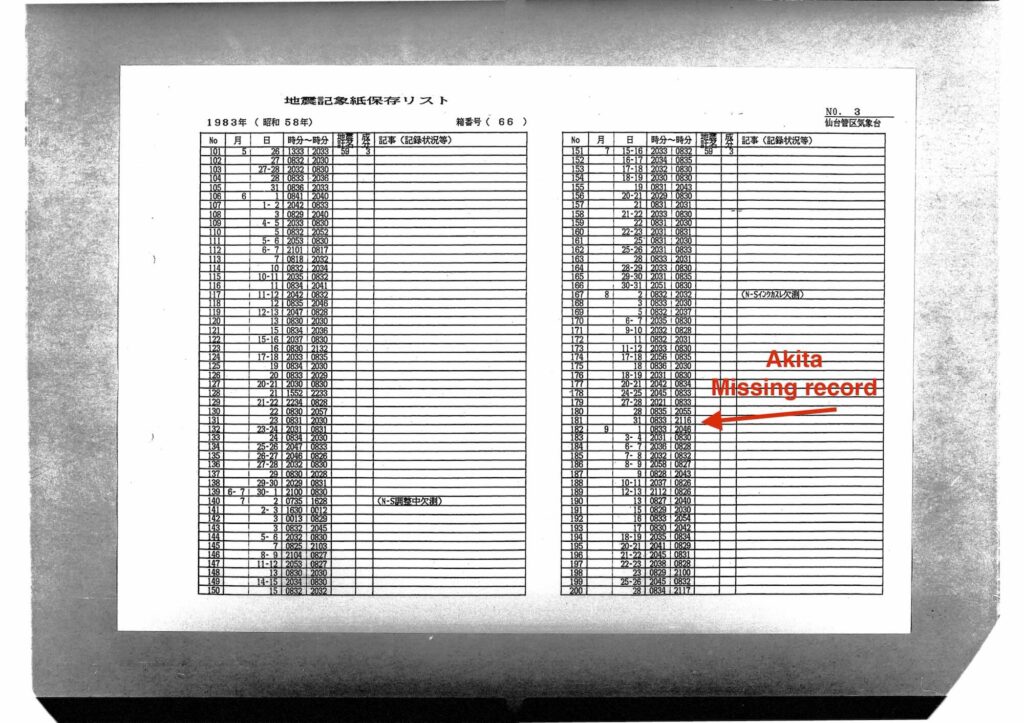
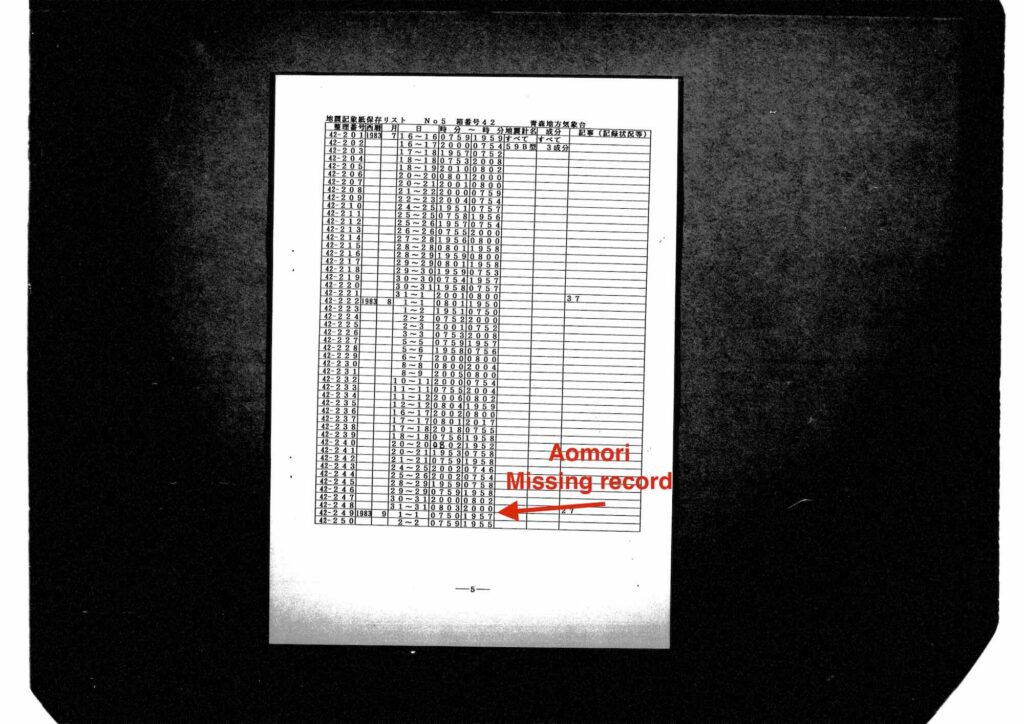
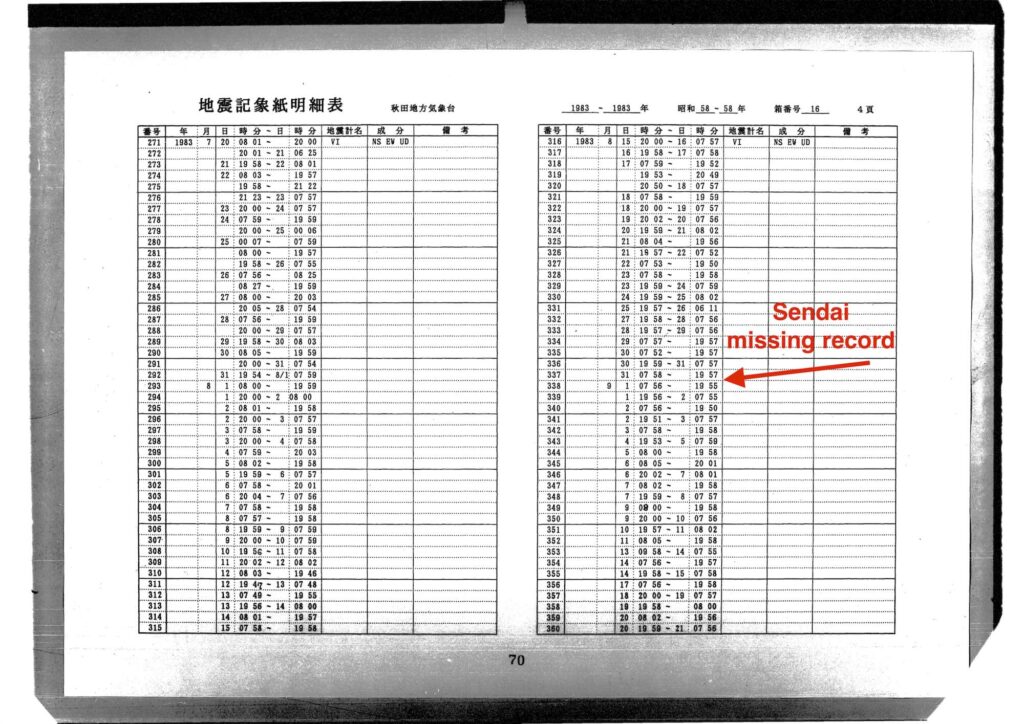
Initially I was disappointed but then I realised that this meant the period in question was seismically quiet and therefore if any records could be found then chances of finding a small signal would be high.
I also realised I had asked this Japanese professor specifically for the records from Akita, Aomori and Sendai and he had attempted to do exactly that. I then realised by browsing the university bulletins they publish that Tohoku and university ran its own network of seismograms and this network was denser than that of JMA. Seismograms were located at each of the following locations and were operational at the time.
- OGA – Oga (from Nov 1967), plus a temporary station in 1983
- NIB – Nibetsu (May 1969)
- HOJ – Honjo (Dec 1967)
- FUT – Futatsui (Dec 1967)
- TBS – Tobishima (Sep 1974)
- SBT – Shibata (1981)
- HRD – Hirosaki campus (Apr 1981)
- IWS – Iwasaki (Dec 1982)
- TMR – Tomari, Shimokita (Dec 1982)
- MMA – Minmaya (Feb 1983)
Of particular interest is the stations at Oga and on Tobishima Island. These are very close to where debris drift and radio comms put the impact. There was intense scientific interest in this region at the time due to the large earthquake on May 26, 1983 and the resulting aftershocks. It seems likely that paper records from the JMA and university sites still exist. I have requested the seismic professor make enquires into the the existence of any of these records.
I put an enquiry in at Headquarters for Earthquake Research Promotion (HERP) of Japanese government http://www.susu.adep.or.jp/index.html for the paper records of any station in the general area of interest.
I also performed another search of their database. This I had done numerous times before but there were never any records close to the period of interest. However, this time I received one result. A seismogram recorded at Matsushiro which is in Nagano had just been digitised. It is not ideal being approximately 400km from the area of interest but covered the time period of the morning of Sept 1, 1983.
Even more interesting is there is a very small signal on the vertical trace at exactly 4:38:45.
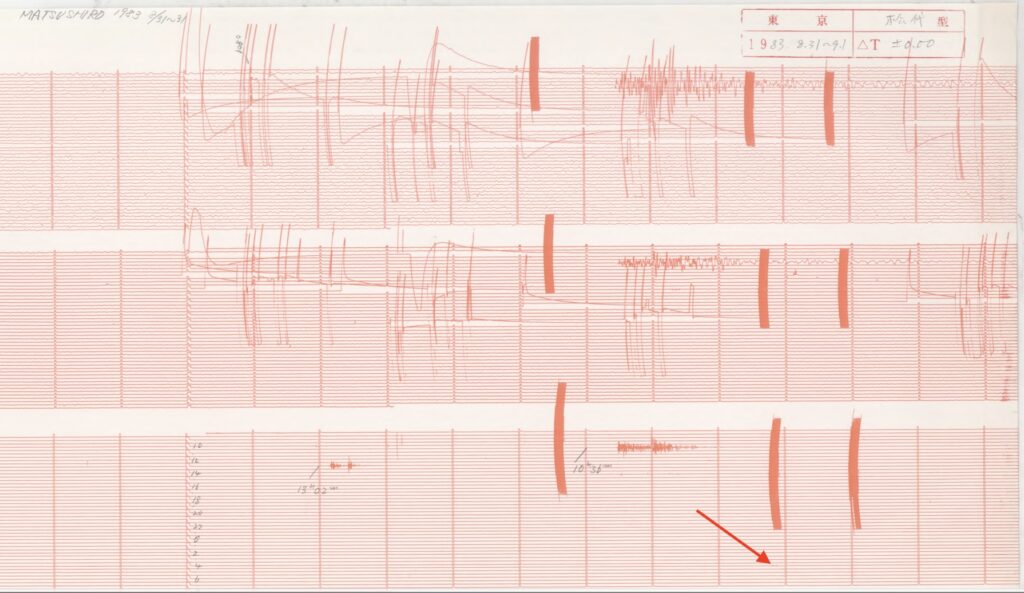

According to Brun, KAL007’s last radio transmission was at 4:13:16 and he believes it may have been the start of a mayday call. Whilst this small signal is plausibly from KAL007 impact it would need to be observed at other observatories to eliminate it as noise or a local event. Whilst it is difficult to see, there appears to be two events separated by about 4 seconds.
If this is the first timing of KAL007 it shows that it was flying for about 25 minutes after its last radio transmission. This would mean KAL007 was in a semi controlled spiral descent, not a fall from the sky.
More importantly the rest of the seismogram shows the time of interest is a very quiet period seismically speaking. It also confirms the existence of paper records that are still being digitised. Hopefully HERP will return some positive news in relation to other records.